Showing posts with label Case Study: McCormick. Show all posts

Case Study: 5 Categories of BI Identified for McCormick

To represent Business Intelligence (BI) projects of McCormick, use the five categories of BI that identified for McCormick. In actual practice, there might well be more than five projects, but let’s use five that will suffice. There are several ways to go about creating the BI opportunity map, one of which is to have one person array the projects within the opportunity map quadrants as the starting point for discussions with knowledgeable business and IT leaders and managers. If this approach is used, the initial BI opportunity map for McCormick might look like below:

Click on image to enlarge
  • All projects were judged to have a very positive business impact owing to strong alignment with company strategies and core business processes. Manufacturing BI was considered to have relatively less business impact because supply chain costs are a much higher proportion of total finished goods costs than are manufacturing costs. Financial planning and control BI was felt to provide lagging indicators, whereas product development BI, SCM BI, and customer service BI were judged to have more direct impacts on McCormick’s ability to execute its business strategies and value disciplines.
  • The projects were judged to have different risk characteristics based on the relative technical difficulty of acquiring and integrating the data needed to delivery the information from the source systems that contain the data, the availability and quality of the underlying data needed to deliver the information, and a number of organizational readiness factors.

Business and IT leaders and managers can use the initial BI opportunity map as the starting point for discussions addressing the underlying assumptions of the initial project placements, and then they can potentially adjust those placements, as illustrated as below: 

Click on image to enlarge
In the example above, the discussion of risk-reward tradeoffs resulted in a group consensus that:

  • Manufacturing BI had greater business impact and greater risk than originally perceived, as indicated by the manufacturing BI box.
  • SCM BI had greater business impact and less risk than originally perceived, as indicated by the SCM BI box.

Based on these discussions and the relative placement of the projects within the BI opportunity map, McCormick might then prioritize its BI opportunities as follows:
  1. SCM BI
  2. Product development BI
  3. Customer service BI
  4. Financial planning and control BI
  5. Manufacturing BI
These priorities would then establish the order in which the specific BI development projects would be undertaken.
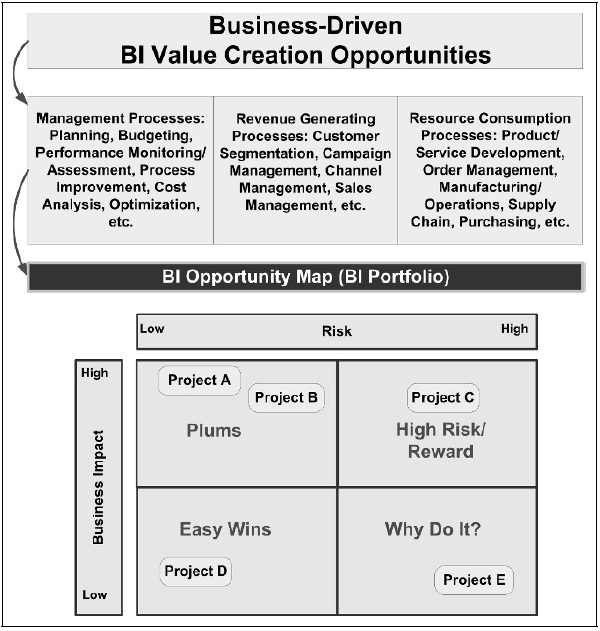
Case Study: McCormick Driven Business Intelligence Value Creation Opportunities

Based on McCormick’s industry environment, business drivers, strategies, goals, and business design, the following Business Intelligence (BI) opportunities can be idenitified. Each would help McCormick improve profit and performance.  

  • Product development BI. Examples include sales trends by consumer end product categories such as beverages and baked goods, sales trends by McCormick customer and by McCormick ingredient product, and gross margin and volume trends for McCormick products. 
  • Customer service BI. Examples include customer profitability trends by customer and by consumer end-product category, such as dairy products and baked goods, and customer-specific order history, including order line volumes, frequency of orders, frequency of order changes, and order fulfillment metrics. 
  • SCM BI. Examples include demand history by McCormick product and by customer, supplier scorecards for McCormick suppliers, inventory levels by McCormick product and by customer, and performance metrics such as order-tocash cycle time, order-to-ship cycle time, and percentage of perfect orders. 
  • Manufacturing BI. Examples include batch yield history by McCormick product and plant, batch cost history by McCormick product and plant, quality trends by McCormick product and plant, and batch setup and changeover time trends by McCormick product and plant. 
  • Financial planning and control BI. Examples include forecast versus actual order volume, prices, and mix by McCormick product and by customer; forecast versus actual revenues by McCormick region, product, customer, and salesperson; and forecast versus actual gross margin by McCormick product and plant.
By systematically working through the BI opportunity analysis framework, we have identified specific BI opportunities for McCormick. By investing in one or more of these BI opportunities, McCormick would have better business information and analytical tools to inform key business decisions that drive increased profits. For example, industry consolidation puts pressure on profit margins. 

McCormick has chosen to respond to this challenge by adopting a strategy of supply chain collaboration, which seeks to drive costs down by using IT and business process improvements to improve operational efficiency. Toward that end, having SCM BI and customer service BI would allow McCormick manage the key variables and processes that determine supply chain costs, time, asset utilization, service, and quality—all of which contribute to the ability to maintain or improve gross margins in the face of margin pressures.

The McCormick BI opportunity analysis case study illustrates how your company could go about identifying actionable BI opportunities. The process does not stop there, however, as you then need to prioritize those opportunities based on business impact, risk, and project interdependencies. The next part of this BI opportunity analysis overview describes a straightforward method for prioritizing your BI opportunities.

Click on image to enlarge

Figure above shows the continuation of the BI opportunity analysis from the point of having identified opportunities of business-driven BI value creation to the point of having used a portfolio of BI opportunities to create a BI opportunity map. The BI opportunity map is a conceptual framework aimed at prioritizing BI opportunities based on what amounts to a risk-reward tradeoff. 

The opportunity map should not be thought of as a deterministic model, although opportunities are present to use multi-factor quantitative and/or qualitative analyses to support project placement on the business impact scale and/or the risk scale. Rather, the BI opportunity map serves as a basis for riskreward tradeoff discussions between the business and IT leaders and managers who collectively have to sponsor, execute, and leverage the contemplated BI investments so that business value is created. To illustrate the use of the BI opportunity map, let’s continue the analysis of the McCormick case.

Case Study: McCormick Opportunity Analysis

Worth $2 billion McCormick commonly known as manufacturer of food and beverage ingredients. Based solely on publicly available information, this section shows you step by step how McCormick might analyze its Business Intelligence (BI) opportunities and applied that analysis to improve its profits and operating effectiveness. McCormick sells materials to the food and beverage processors, after processing, they sells them to retailers of food and beverages. The food industry is a mature, fragmented, international industry that is undergoing substantial structural changes typical of industry evolution.

Changes in the food and beverage retailing industry affect the food and beverage processing industry (McCormick’s customers). The resulting changes to the food and beverage processing industry affect McCormick’s business. From a BI strategy perspective, this case study most interested in changes that affect McCormick’s customers and how they make money. The nature and extent of those changes may create opportunities for McCormick to use BI to its strategic and competitive advantage.

Evolution of McCormick’s Relevant Industries
There are three key industries were relevant to McCormick’s BI planning: the food and beverage retail industry, the food and beverage processing industry, and the food and beverage ingredients industry. The food and beverage retail industry has historically been fragmented and regional. By 1999, however, it had become increasingly concentrated and global. In the United States, the top 10 supermarket players generated 33% of industry sales in 1995, but by 1999 that figure stood at 45%, not counting Wal-Mart’s 12% market share.

By 2004, the industry structure had the top 10 players holding between 55% and 70% of the market. Overall, the industry is a mature, consolidating, slow-growth industry with intense competition based on price, which means food and beverage processors receive pressure from the retailers to reduce prices, improve supply chain effectiveness, and differentiate themselves on more than just brand image. It is typical that mature industries spawn more aggressive competition based on cost and service, and that is certainly the model that Wal-Mart has used effectively in the consumer packaged goods industry. It is also typical that profits in the mature industry often fall, sometimes permanently.

The food and beverage processing industry is affected by trends at the retail level. The McCormick company’s primary interest is in identifying the major trends and their likely impact on the bases of competition in its ingredients businesses. This will suggest potential areas where McCormick can leverage BI.

The balance of power between food retailers and food processors shifted from 1995 to 2005 in favor of the retailers, which continues to put pressure on pricing and profits. The food processing companies most threatened by retailer consolidation are those with lower-ranking brands. In addition, slow domestic economic growth has intensified competition, motivated global expansion, and driven business process reengineering projects seeking improved margins.

Many industry leaders spent the mid-90s engaged in cost-cutting initiatives and backward integration into the ingredients industry, and such initiatives have returned as much benefit as they are likely to in the short term. Thus, the food and beverage processing industry is consolidating, which increases buyer power in relation to McCormick and its competitors. Looking forward, McCormick can continue to expect pricing pressures and demands for increased efficiency as its customers seek to maintain their own profitability in the face of slow growth and retailer consolidation.

The food and beverage ingredients industry is similar in structure to that of the related downstream industries: mature, slow growth, fragmented, and increasingly global. Faced with increasing customer power owing to concentration and supplier consolidation programs, price pressures due to customer industry dynamics, and the threat of backward integration, ingredients industry firms are themselves merging in an attempt to maintain some balance of power.

Although the overall growth rate of the ingredient industry is low, opportunities for growth in excess of the industry average are present. Industry players segment the market into what might be called macro-categories, for example, beverages, baked goods, dairy, candy/confection, and snack foods. These macro-categories have different growth rates, different leading brands, and different rates of new product development, all of which contribute to different opportunity profiles and growth potential.

Consistent with this overall environment, McCormick has successfully executed a strategy that is at once focused, differentiated, and based on cost leadership. McCormick is focused because it is only in the ingredients business. It is differentiated because its customer-based product development paradigm was at one time a singular position in the industry, and because it offers a broader product line than its competitors. The McCormick strategy is also based on cost leadership because it consistently focuses on margin improvement, global sourcing, and supply chain management (SCM) as means to achieve low-cost producer status.

Summary of Food Industry Drivers and Trends
Given the multiple levels of consolidation in the industry, each customer relationship takes on increased importance. At the same time, it’s also imperative to improve costs, pricing, customer selection, and customer revenue management. This suggests that growth and profitability could be enhanced by effective use of BI that supports those objectives. It also suggests that customer-focused business strategies and operating policies will be at least as important as, and probably more important than, they have traditionally been. Accordingly, BI capabilities that promote top-caliber customer service and make it easy to do business with McCormick are also important. A summary of the food industry drivers and trends is shown below:

Click on image to enlarge

Application of the Business Intelligence Opportunity Analysis Framework at McCormick
Working with the publicly available facts described above, the BI opportunity analysis framework can be applied to systematically identify specific opportunities to use BI to improve profits at McCormick. Both top-down and bottom-up BI opportunity analysis techniques can be used. Although top-down techniques begin with a strategic view and work down into an operational view, many business users are more comfortable discussing operational priorities. In this case, bottom-up techniques are used to discuss BI in relation to business processes, and determine how it can be used to support business strategies and the achievement organizational goals and objectives. The analytical results, abbreviated for sake of illustration, might look like this:

Business Drivers:
  • Consolidation
  • Wal-Mart factor
  • Increased pricing pressures
  • Slow growth
  • Global expansion
  • IT as a competitive weapon
McCormick Business Strategies, Goals, and Objectives:
  • Retain/increase revenue and market share through developing a broad line of differentiated products and services.
    Reduce costs and improve service through strengthening supply chain collaboration and improving sales forecasting.
  • Improve profits by utilizing customer segmentation approaches to identify the most profitable customers and retain these customers by providing high-quality, differentiated service and support.
  • Preserve margins by refining pricing strategy to determine the potential short-term and long-term cost/benefit of adjusting prices for different customers and segments; make pricing decisions based on cost/benefit analysis.

McCormick Business Design
Value Disciplines
  • Customer knowledge
  • Consumer-focused product development
    Leveraged IT
    Continuous process improvement
    Niche focus
Core Business Processes
  • Product development
  • Customer service
  • Supply chain management (SCM)
  • Manufacturing
  • Financial planning and control
 
Copyright © 2011. BI Articles and Study Case - All Rights Reserved
Proudly powered by Blogger